Degraded-Mode Batch Push: Resilience to Datacenter Failures#
Problem Statement#
Currently, a multi-datacenter batch push fails entirely if any single DC fails. This is enforced at three layers:
- Parent controller (
VeniceParentHelixAdmin.getFinalReturnStatus()): ERROR has higher priority than COMPLETED in status aggregation; an unreachable DC with terminal status forces ERROR. - VPJ polling (
VenicePushJob.pollStatusUntilComplete()): Success requires all DCs to report completion —completedDatacenters.size() != regionSpecificInfo.size()causes an exception. - Deferred swap (
DeferredVersionSwapService): A failed target region results in the version being KILLED.
The goal is to allow pushes to succeed in a "degraded mode" when a known-down DC fails but all healthy DCs complete successfully.
Current Multi-DC Push Architecture (Native Replication)#
With native replication (NR), VPJ writes data directly to the Version Topic (VT) in the NR source fabric. Other DCs replicate from that fabric's VT. The parent controller is control-plane only — it handles version creation, admin messages, and status aggregation, but does NOT host a "parent VT" for data.
Status Aggregation Flow#
┌─────────────────────────────────────────────────┐
│  Child Controller (per DC)                       │
│  Replicas → Partition Status (PushStatusDecider) │
│  Partitions → Overall DC Status                  │
│  Strategy: WaitAll or WaitNMinusOne              │
└──────────────────────┬──────────────────────────┘
                       ↓
┌─────────────────────────────────────────────────┐
│  Parent Controller (control plane only)          │
│  1. Query all DCs                                │
│  2. Sort statuses by STATUS_PRIORITIES           │
│  3. Majority check (>50% DCs reachable)          │
│  4. Terminal + unreachable DC → ERROR            │
│  Result: Aggregated status + per-region details  │
└──────────────────────┬──────────────────────────┘
                       ↓
┌─────────────────────────────────────────────────┐
│  VenicePushJob Polling                           │
│  1. Poll parent controller periodically          │
│  2. Success: terminal + ALL DCs completed        │
│  3. Failure: terminal + ANY DC not completed     │
│  4. Timeout: UNKNOWN > 30 minutes                │
└─────────────────────────────────────────────────┘
Key Enforcement Points#
| Location | File | Behavior |
|---|---|---|
| Status priority sort | VeniceHelixAdmin.java:348-364 | ERROR dominates COMPLETED in aggregation |
| Unreachable DC check | VeniceParentHelixAdmin.java:4411-4421 | Unreachable DC + terminal → forces ERROR |
| VPJ completion check | VenicePushJob.java:2674 | All DCs must complete for success |
| VPJ PARTIALLY_ONLINE | VenicePushJob.java:2727-2731 | Throws exception on PARTIALLY_ONLINE |
| Deferred swap | DeferredVersionSwapService.java:502-504 | PARTIALLY_ONLINE is terminal — no further recovery |
| Version retirement | VeniceHelixAdmin.java:4490 | Child controller retires old versions after new goes ONLINE |
Existing Building Blocks#
| Component | File | What It Does |
|---|---|---|
| Targeted region push | AdminExecutionTask.java:769-773 | skipConsumption for non-targeted regions (but NOT when deferred swap is enabled — see Critical Fix 1) |
| Deferred version swap | DeferredVersionSwapService.java:706-797 | Partial region rollforward, produces PARTIALLY_ONLINE |
| Emergency source region | VeniceHelixAdmin.java:7808-7847 | Overrides NR source fabric selection at cluster level (highest priority in NR source selection chain) |
| Data recovery | DataRecoveryManager.java:79-117 | Replays missed version by having recovering DC replicate from NR source fabric's VT (always available for current/backup version) |
| Per-DC version tracking | StoreInfo.coloToCurrentVersions | Tracks current version independently per DC |
| PARTIALLY_ONLINE status | VersionStatus.java:47-50 | Represents "serving in some DCs but not all" |
| WaitNMinusOne strategy | WaitNMinusOnePushStatusDecider.java | Tolerates 1 replica failure per partition (per-replica, not per-DC) |
Critical Issues Any Approach Must Handle#
| # | Issue | Impact | Resolution |
|---|---|---|---|
| 1 | VPJ throws on PARTIALLY_ONLINE | Any approach producing PARTIALLY_ONLINE causes VPJ to fail | Step 3: VPJ accepts PARTIALLY_ONLINE when degraded mode info returned in VersionCreationResponse |
| 2 | VT availability during recovery — recovery needs the VT in the NR source fabric to replay data to the recovering DC | Not an issue: the current version's VT is never cleaned up, and Venice's backup version retention guarantees the VT survives one version transition. If a normal push targets the recovering DC, it naturally heals it — no explicit recovery needed. Parent VT truncation is harmless. | No special handling needed — existing backup version retention is sufficient |
| 3 | NR source fabric = degraded DC — if degraded DC is the NR source, VPJ cannot write data and no DC can replicate | Must redirect NR source to a healthy DC so VPJ writes there and other DCs replicate from it | Step 1: Set cluster-level emergencySourceRegion to a healthy DC |
| 4 | Admin message queue creates ghost versions — skipConsumption is bypassed when versionSwapDeferred=true | Degraded DC creates a version it cannot ingest | Critical Fix 1: Modify AdminExecutionTask to skip for degraded DCs |
| 5 | Incremental push on stale base diverges data — non-AA stores get inconsistent state | Data divergence | Step 6: Block incremental push for non-AA stores with degraded DC |
Design Options Evaluated#
Option A: Modify Core Aggregation Logic ("N-1 DC Strategy")#
Add PUSH_JOB_TOLERATED_DC_FAILURES config. Change getFinalReturnStatus() to count completed vs errored DCs instead of taking highest-priority status. Relax VPJ success condition.
- Pros: Simple concept, backwards-compatible
- Cons: No intelligence about which DC is down; requires changes to aggregation logic (~8+ files); ghost version problem in recovering DCs
Option B: Known-Degraded DC Allow-List with Custom Aggregation#
Operator marks DC as degraded. Filter degraded DCs from getFinalReturnStatus() aggregation. VPJ excludes degraded DCs from completion check.
- Pros: Explicit, operator-controlled
- Cons: Requires new aggregation logic; ghost version problem; ~8+ files changed
Option C: Extend Targeted Region Push (Recommended)#
Auto-convert regular pushes to targeted region pushes that exclude degraded DCs. Leverage existing deferred swap infrastructure.
- Pros: Minimal new code; reuses proven infrastructure; ~6-8 files changed
- Cons: Requires operator intervention to mark/unmark degraded DCs; requires fix to
skipConsumptionlogic
Option D: Automatic DC Health Detection#
Parent controller auto-detects unhealthy DCs via cross-store failure correlation.
- Pros: Fully automated
- Cons: High complexity; false positive risk; new subsystem required
Option E: Two-Phase Push with Automatic Retry#
Push to all DCs; on failure, swap in healthy DCs and queue retry for failed DC.
- Pros: Best user experience
- Cons: Very complex; version divergence risk; ~8+ files; race conditions with subsequent pushes
Recommended Approach: Extend Targeted Region Push (Option C)#
Architecture#
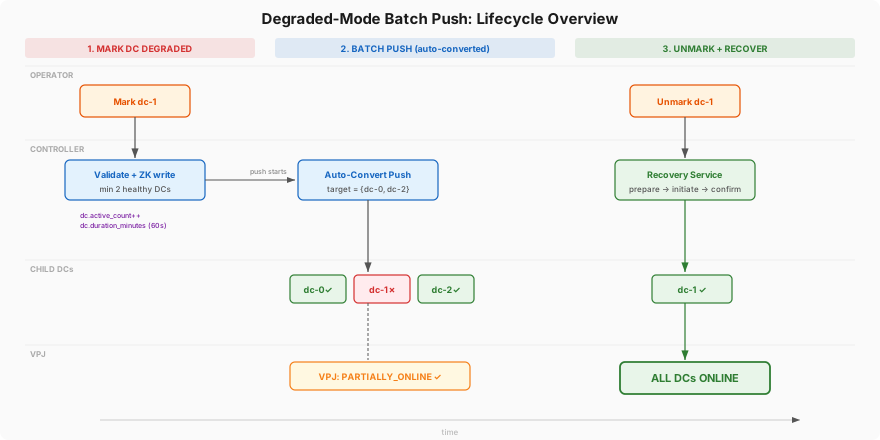
Operator marks DC as degraded (with optional auto-unmark timeout)
  - If degraded DC is NR source, set cluster-level
    emergencySourceRegion to redirect VPJ writes + replication
        ↓
Push submitted (normal VPJ)
        ↓
Controller auto-converts to targeted region push
  - targetedRegions = all DCs except degraded
  - versionSwapDeferred = true
  - Degraded DC: skipConsumption enforced (Critical Fix 1)
  - Controller returns degraded mode info + NR source Kafka URL
    in VersionCreationResponse (Critical Fix 2)
        ↓
VPJ writes data directly to NR source fabric's VT
  (possibly redirected if degraded DC was the NR source)
  - Other healthy DCs replicate from NR source fabric's VT
  - Degraded DC skips consumption entirely
        ↓
Push completes in healthy DCs
  - DeferredVersionSwapService swaps in healthy DCs
  - Version status = PARTIALLY_ONLINE
  - Current version VT intact in NR source fabric (no special retention needed)
        ↓
VPJ detects degraded mode from VersionCreationResponse
  - Enters deferred swap monitoring path
  - Accepts PARTIALLY_ONLINE as success
  - Logs warning with degraded DC details
        ↓
Operator unmarks DC when recovered (or auto-unmark after timeout)
  - Bulk recovery orchestrator triggers DataRecoveryManager per store
  - Recovering DC replicates from NR source fabric's VT (current version, always available)
  - OR: next normal push naturally targets recovering DC (no explicit recovery needed)
  - Cluster-level `emergencySourceRegion` cleared
  - Version transitions PARTIALLY_ONLINE → ONLINE after all stores recover
Implementation Steps#
Step 1: Controller API to Mark/Unmark DC as Degraded#
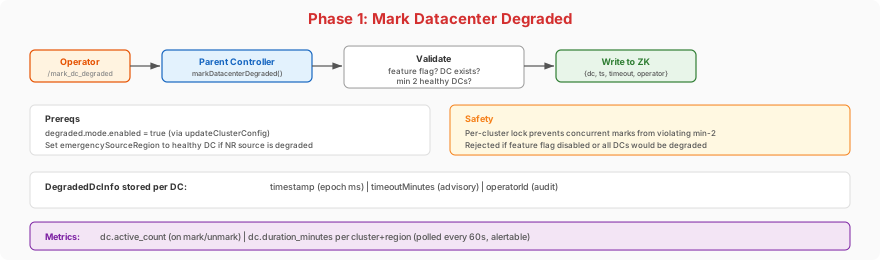
- New admin APIs:
markDatacenterDegraded(dcName, timeoutMinutes)/unmarkDatacenterDegraded(dcName)/getDegradedDatacenters() - Store degraded DC set in ZooKeeper (cluster-level ZNode, e.g.,
/venice-cluster/degraded-dcs)- Use ZK versioned writes (compare-and-swap) to handle concurrent operator updates safely
- Persists across controller leader failovers
- Each entry stores:
{dcName, degradedTimestamp, timeoutMinutes, operatorId}
- Pre-condition: If degraded DC is (or could be) the NR source fabric, set the existing cluster-level
emergencySourceRegionconfig to a healthy DC. This is the highest priority in the NR source selection chain (getNativeReplicationSourceFabric()), so it immediately redirects all stores. For stores whose NR source was already a healthy DC, this is a harmless no-op. - Feature flag: Gated behind cluster-level config
degradedModeEnabled(default:false). Must be explicitly enabled beforemarkDatacenterDegradedis accepted.
Files:
services/venice-controller/src/main/java/com/linkedin/venice/controller/Admin.java— new API methodsservices/venice-controller/src/main/java/com/linkedin/venice/controller/VeniceParentHelixAdmin.java— implementation + cluster-levelemergencySourceRegionmanagementservices/venice-controller/src/main/java/com/linkedin/venice/controller/server/AdminSparkServer.java— REST endpointsinternal/venice-common/src/main/java/com/linkedin/venice/controllerapi/ControllerRoute.java— new route entriesinternal/venice-common/src/main/java/com/linkedin/venice/controllerapi/ControllerClient.java— client methods for VPJ and admin tooling
Step 2: Auto-Convert Push to Targeted Region Push#
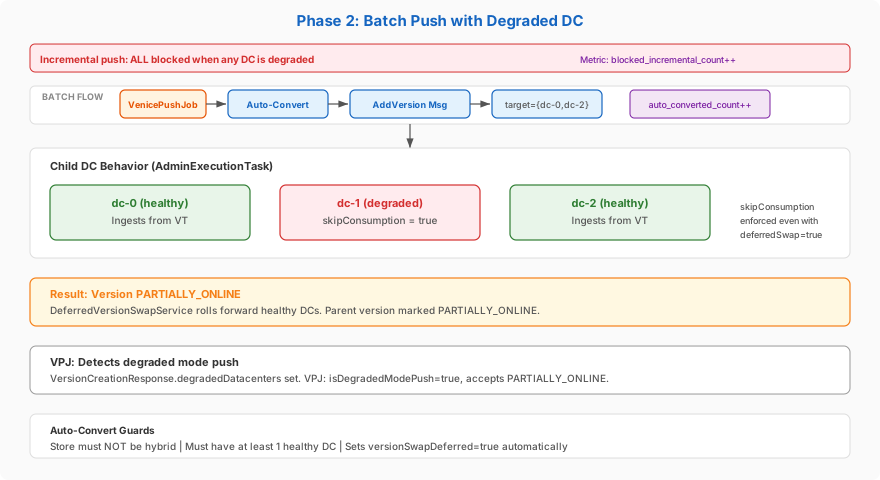
At version creation time in CreateVersion.java (~line 398-415) and VeniceParentHelixAdmin.incrementVersionIdempotent() (~line 1780):
- If degraded DCs exist AND
degradedModeEnabled=trueAND store is NOT hybrid:- Set
targetedRegionsto exclude degraded DCs - Enable
versionSwapDeferred = true - Guard: if ALL DCs are degraded (empty healthy set), throw an error
- Hybrid stores are excluded from auto-conversion (they have separate RT data flow)
- Set
- Return degraded mode info in
VersionCreationResponse— add a new fielddegradedDatacenters(list of excluded DC names) so the VPJ can detect the auto-conversion and enter the correct polling code path. This fixes Critical Flaw 2.
Files:
services/venice-controller/src/main/java/com/linkedin/venice/controller/server/CreateVersion.javaservices/venice-controller/src/main/java/com/linkedin/venice/controller/VeniceParentHelixAdmin.java—addVersionAndStartIngestion()internal/venice-common/src/main/java/com/linkedin/venice/controllerapi/VersionCreationResponse.java— adddegradedDatacentersfield
Step 3: Fix skipConsumption for Degraded DCs (Critical Fix 1)#
The current AdminExecutionTask.java:769-773 bypasses skipConsumption when versionSwapDeferred=true:
if (skipConsumption && !isTargetRegionPushWithDeferredSwap) {
    // SKIP
} else {
    admin.addVersionAndStartIngestion(...); // Executes even for excluded DCs!
}
Fix: Add a degraded-DC-aware condition. When a DC is in the degraded set, it must skip consumption regardless of versionSwapDeferred:
boolean isDegradedDC = degradedDatacenters.contains(regionName);
if (skipConsumption && (!isTargetRegionPushWithDeferredSwap || isDegradedDC)) {
    // SKIP — degraded DCs always skip
} else {
    admin.addVersionAndStartIngestion(...);
}
The degraded DC set must be available to AdminExecutionTask. Options:
- Pass it in the admin message (new field in the ADD_VERSION message)
- Or read it from ZK at consumption time
Files:
services/venice-controller/src/main/java/com/linkedin/venice/controller/kafka/consumer/AdminExecutionTask.java— fixskipConsumptionlogic
Step 4: Handle PARTIALLY_ONLINE in VPJ (Critical Fix 2)#
Modify VPJ to detect and handle auto-converted degraded pushes:
- After receiving
VersionCreationResponse, check the newdegradedDatacentersfield - If non-empty, set internal flag
isDegradedModePush = trueand setisTargetRegionPushWithDeferredSwap = true - In
pollStatusUntilComplete(), whenisDegradedModePush=true:- Accept
PARTIALLY_ONLINEas a successful terminal state (guard exception at line 2727-2731) - Skip the
targetRegionSwapWaitTimetimeout (line 2742-2750) since the degraded DC will never complete during this push - Log a WARNING with the list of degraded DCs
- Emit a metric
push.completed.degraded.count
- Accept
Files:
clients/venice-push-job/src/main/java/com/linkedin/venice/hadoop/VenicePushJob.java—pollStatusUntilComplete()
Step 5: VT Retention — No Special Handling Needed#
No code changes required for VT retention. The existing backup version retention policy is sufficient.
Why: Venice retains one backup version in addition to the current version. A PARTIALLY_ONLINE version produced by a degraded-mode push is the current version in healthy DCs — its VT in the NR source fabric is never cleaned up. Recovery targets the current version, whose VT is guaranteed to exist.
Scenario analysis during recovery:
| Scenario | VT State | Recovery Action |
|---|---|---|
| No new push since degraded-mode push | VT of current version exists in NR source fabric | DataRecoveryManager replays current version to recovering DC |
| New push (v7) in progress | v6 is still current, VT intact | Recovery continues on v6 |
| New push (v7) completes mid-recovery | v6 becomes backup, VT still intact (backup retained) | Recovery continues uninterrupted on v6 |
| v7 is a normal push (DC unmarked, all DCs targeted) | v7 naturally targets recovering DC | No explicit recovery needed — v7 IS the recovery |
| v7 is another degraded push (DC still excluded) | v6 backup VT intact; v7 becomes current | Abandon v6 recovery if incomplete; re-run for v7 |
Parent VT note: Parent VT truncation (by handleTerminalJobStatus() and DeferredVersionSwapService) is harmless — it only affects the parent's local copy used for concurrent push detection, not the NR source fabric's data VT.
Files: None — no code changes needed for this step.
Step 6: Block ALL Incremental Pushes During Degraded Mode#
In the incremental push entry point (VeniceParentHelixAdmin.incrementVersionIdempotent()):
- If
isDegradedModeEnabledAND any DC is degraded AND the push is incremental:- Throw: "Incremental push blocked: DC(s) {names} are degraded."
- All incremental pushes are blocked, regardless of AA status. The original design allowed AA-enabled stores to proceed, but during implementation we decided to block all incremental pushes for simplicity and safety — even AA-enabled stores could have consistency issues if the degraded DC's RT is stale.
Files:
services/venice-controller/src/main/java/com/linkedin/venice/controller/VeniceParentHelixAdmin.java
Step 7: Version Retention — No Special Handling Needed#
No code changes required. The existing backup version retention policy already provides the safety margin needed for recovery:
- Venice retains one backup version in addition to the current version
- The current version's VT is never cleaned up
- If a new push completes during recovery, the previous version becomes backup — its VT is still intact
- A normal push targeting the recovering DC naturally heals it, making explicit recovery unnecessary
Files: None — no code changes needed for this step.
Step 8: Recovery When DC Comes Back#
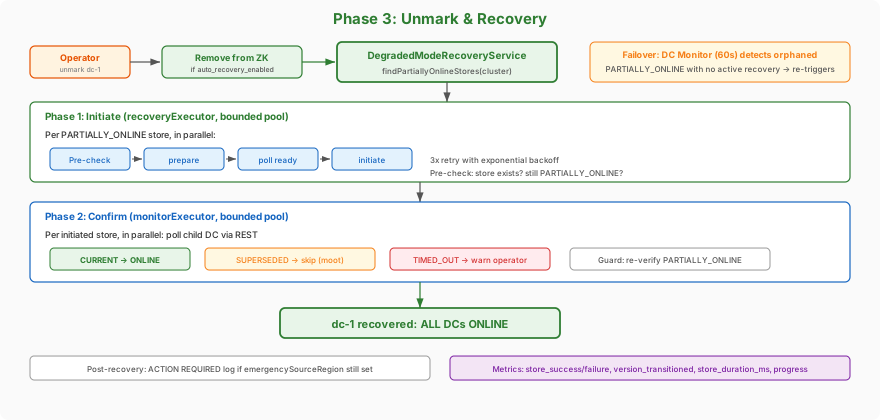
On unmarkDatacenterDegraded(dcName):
- Enumerate affected stores: Scan all stores for the highest PARTIALLY_ONLINE version per store.
- Bulk recovery orchestrator (
DegradedModeRecoveryService):- Phase 1 — Initiation (parallel, bounded thread pool, configurable size):
- Pre-check: verify store exists and version still PARTIALLY_ONLINE
- Resolve NR source fabric (respects emergencySourceRegion override)
admin.prepareDataRecovery()→pollUntilReady()→admin.initiateDataRecovery()- Retry up to 3x with exponential backoff on failure
- Phase 2 — Confirmation (parallel, bounded monitor pool):
- Poll child DC via
getCurrentVersionInRegion()until version is current - Handle version supersession: if a newer version becomes current, treat as success (recovery moot)
- On confirmation:
updateStoreVersionStatus()transitions PARTIALLY_ONLINE → ONLINE - Re-verifies version is still PARTIALLY_ONLINE before transitioning (prevents stale updates)
- Poll child DC via
- Tracks progress:
{totalStores, recoveredStores, failedStores, versionsTransitioned} - Exposes progress via REST API:
GET /get_recovery_progress?cluster=X&datacenter_name=Y - Recovery keyed by
cluster/datacenterto prevent multi-cluster collisions - Uses atomic
compute()to prevent concurrent recovery races
- Phase 1 — Initiation (parallel, bounded thread pool, configurable size):
- emergencySourceRegion reminder: Logs ACTION REQUIRED if emergencySourceRegion is still set after all stores recover. Clearing is a manual operator action (static config).
- Leader failover safety: Periodic DC monitor (60s) scans for orphaned PARTIALLY_ONLINE versions with no active recovery. Re-triggers recovery idempotently (prepare cleans up previous state).
Files:
services/venice-controller/src/main/java/com/linkedin/venice/controller/DegradedModeRecoveryService.javaservices/venice-controller/src/main/java/com/linkedin/venice/controller/VeniceParentHelixAdmin.javaservices/venice-controller/src/main/java/com/linkedin/venice/controller/Admin.java
Step 9: Degraded DC Duration Monitoring (Alert-Only)#
A periodic background task (every 60 seconds) in DegradedModeRecoveryService:
- Emits
degraded_mode.dc.duration_minutesgauge per cluster + region (alertable metric) - If a DC has been degraded longer than
timeoutMinutes: logs a WARN-level ALERT - No automatic unmark — operator must decide when to unmark. The
timeoutMinutesfrommarkDatacenterDegradedis advisory only, used for alerting thresholds.
Files:
services/venice-controller/src/main/java/com/linkedin/venice/controller/DegradedModeRecoveryService.javaservices/venice-controller/src/main/java/com/linkedin/venice/controller/stats/DegradedModeStats.java
Metrics and Observability#
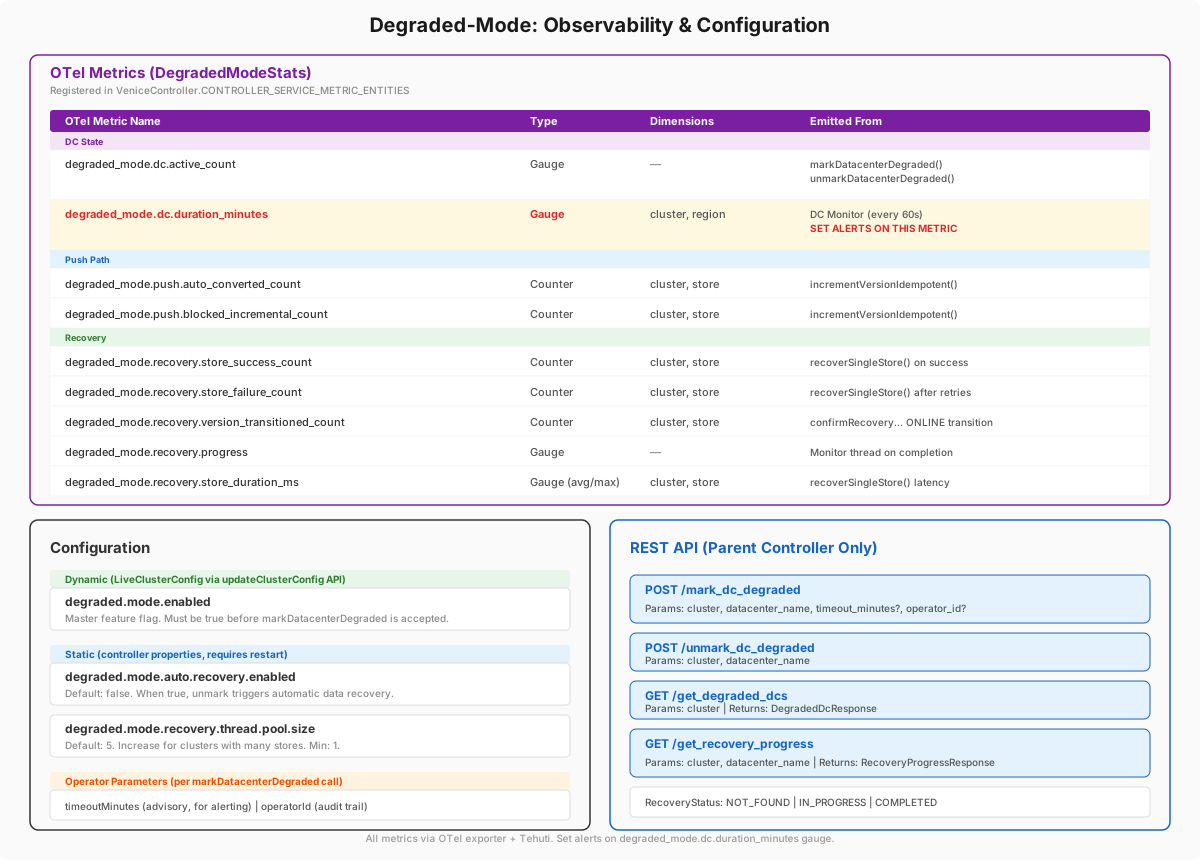
| Metric | Type | Description | | ----------------------------------------------------- | ------------- | ---------------- | ---------------------------------------------------------- | | OTel Metric Name | Type | Dimensions | Description | | ----------------------------------------------------- | ------------- | ---------------- | ---------------------------------------------------------- | | degraded_mode.dc.active_count | Gauge | - | Number of currently degraded DCs | | degraded_mode.dc.duration_minutes | Gauge (ALERT) | cluster, region | How long each DC has been degraded. Set alerts on this. | | degraded_mode.push.auto_converted_count | Counter | cluster, store | Pushes auto-converted to targeted region push | | degraded_mode.push.blocked_incremental_count | Counter | cluster, store | Incremental pushes blocked due to degraded DC | | degraded_mode.recovery.store_success_count | Counter | cluster, store | Individual store recoveries initiated successfully | | degraded_mode.recovery.store_failure_count | Counter | cluster, store | Individual store recoveries failed after all retries | | degraded_mode.recovery.version_transitioned_count | Counter | cluster, store | Versions transitioned PARTIALLY_ONLINE -> ONLINE | | degraded_mode.recovery.progress | Gauge | - | Recovery progress (0.0 to 1.0) | | degraded_mode.recovery.store_duration_ms | Gauge avg/max | cluster, store | Per-store recovery latency in milliseconds |
Edge Cases & Mitigations#
| Edge Case | Mitigation |
|---|---|
| Degraded DC is NR source fabric | Step 1: Set cluster-level emergencySourceRegion to a healthy DC. Redirects VPJ writes and cross-DC replication for all stores. Harmless no-op for stores already using the target DC. |
| Incremental push during degraded mode | Step 6: Block ALL incremental pushes when any DC is degraded (regardless of AA status) |
| Hybrid/AA stores with RT writes | Self-healing via conflict resolution once DC catches up; acceptable |
| Repush during degraded mode | No special handling — repush also auto-excludes degraded DC; current version VT always available |
| Next push while DC catching up | New push also auto-excludes still-recovering DC (same mechanism) |
| Multiple DCs fail simultaneously | Existing majority-reachable check prevents push if >50% DCs down |
| Ghost versions in degraded DC | Step 3: Fix AdminExecutionTask to enforce skipConsumption for degraded DCs |
| VPJ doesn't know about auto-conversion | Step 2: Return degradedDatacenters in VersionCreationResponse; Step 4: VPJ detects and adapts |
emergencySourceRegion is cluster-level | Step 1: Use the existing cluster-level config — it's the simplest approach and harmless for unaffected stores |
| Source version retired before recovery | Not a concern — current version VT always exists; backup version retention provides one version of safety margin; normal push naturally heals recovering DC |
| Operator forgets to unmark DC | Step 9: Auto-unmark timeout with alerts |
| No way to disable degraded mode quickly | Step 1: Gated behind degradedModeEnabled feature flag |
| Compression dictionary availability | Not a concern — dictionary is in the SOP message of the current version's VT, which is always available. Parent VT truncation is harmless. |
| Controller leader failover | Step 1: Degraded DC set stored in ZK, survives failover. emergencySourceRegion is a controller config that persists across restarts. |
| Concurrent operator mark/unmark | Step 1: ZK versioned writes (CAS) prevent lost updates on degraded DC set |
| In-flight push when DC marked degraded | Does not affect current push (only affects new pushes at version creation). Operator should wait for in-flight push to complete/fail before marking. |
| Store migration during degraded mode | DataRecoveryManager rejects recovery for migrating stores. Recovery must wait until migration completes. Alert operator. |
| PARTIALLY_ONLINE versions accumulate | Normal version retirement applies — no special handling needed; recovery targets latest version only |
| Recovery fails for some stores | Step 8: Retry with limit; expose failures via getRecoveryProgress() API; alert on persistent failures |
| Post-recovery data correctness | Step 8: Validate partition count and record count between source and recovered DC |
Industry Alignment#
This design was validated against industry patterns. Full analysis in docs/architecture/degraded-mode-review.md.
| Aspect | Venice | Industry Norm | Assessment |
|---|---|---|---|
| Core pattern | Exclude unhealthy DC from writes | Cassandra LOCAL_QUORUM, Kafka independent consumers, DynamoDB regional independence | Well-aligned |
| Detection | Operator-driven | Mostly automatic (CockroachDB Raft, Cassandra gossip) | Conservative but justified — batch pushes not latency-critical, false-positive cost high |
| Degradation status | Explicit PARTIALLY_ONLINE | Usually implicit | Strength — better operational visibility |
| Recovery | Version replay from sibling DC | Cassandra anti-entropy repair, CockroachDB Raft snapshot, Kafka offset replay | Well-aligned; simpler due to atomic version model |
| Success criteria | All non-degraded DCs must complete | Tunable quorum (Cassandra) | Simpler; appropriate for version-level pushes |
Gaps addressed from industry review:#
- Auto-unmark timeout (circuit breaker pattern) → Step 9
- Recovery progress tracking → Step 8 with
getRecoveryProgress()API - Feature flag for quick disable → Step 1 with
degradedModeEnabled - Metrics/observability → Metrics section added
Deferred to future phases:#
- Per-store degradation policy (some stores may prefer to fail rather than proceed without a DC)
- Automatic DC health detection (auto-suggest degradation based on cross-store failure correlation)
- Pre-degradation health signals (per-DC push health metrics)
Verification Plan#
- Unit tests: Mock degraded DC set in controller tests — verify auto-conversion to targeted region push
- AdminExecutionTask test: Verify
skipConsumptionis enforced for degraded DCs even withversionSwapDeferred=true - VPJ test: Verify VPJ detects
degradedDatacentersinVersionCreationResponseand acceptsPARTIALLY_ONLINE - Integration test: Extend
TestDeferredVersionSwapWithFailingRegions.javato cover:- Mark DC as degraded → push succeeds in healthy DCs → version is PARTIALLY_ONLINE
- Unmark DC → data recovery triggered → version transitions to ONLINE
- NR source fabric test: Mark NR source as degraded → verify cluster-level
emergencySourceRegionis set → push uses alternate source - Incremental push guard test: With degraded DC, attempt incremental push on non-AA store → verify it is blocked
- VT availability test: Verify current version VT exists in NR source fabric after degraded-mode push; verify backup version retention preserves VT through one version transition
- Feature flag test: Verify
markDatacenterDegradedis rejected whendegradedModeEnabled=false - End-to-end multi-DC test: Use
ServiceFactorymulti-region wrapper to simulate full degraded-mode lifecycle